


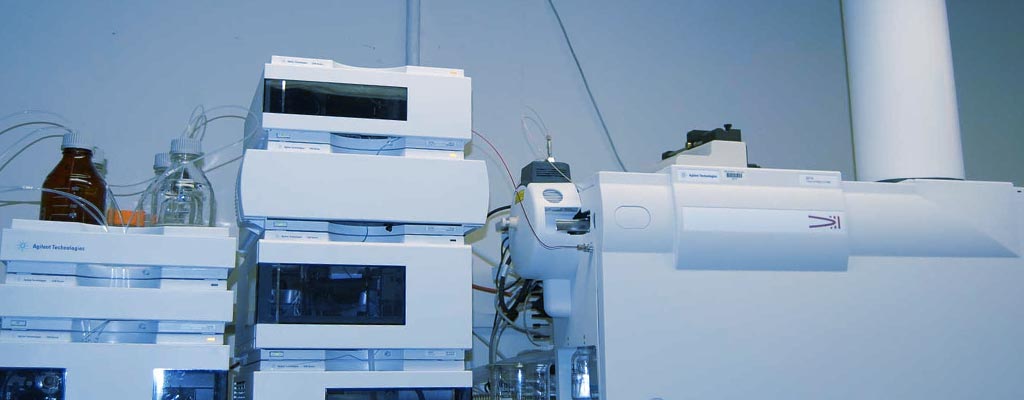
Mass spectrometry (MS) is nowadays the standard technique for the recognition, characterization and measurement of elements, compounds and macromolecules.
Mass spectrometry has become invaluable across a broad range of fields and applications, including chemistry, biology, drug-toxicology, proteomics, metabolomics, genetics and any scientific discipline interested in the characterization and measurement of elements and molecules. All valuable national and international universities and research centers stand out for mass spectrometry instrument facilities. Applications of MS to complex mixtures, such as in biomedical sciences and biotechnology, usually contemplate coupling it with molecular separation techniques (e.g. chromatography or electrophoresis) although it is also possible to directly analyze samples without any previous separation.
- UltrafleXtreme MALDI-TOF/TOF mass spectrometer (Ultraflextreme Bruker). The UltrafleXtreme TOF/TOF mass spectrometry system is designed to work both in linear and reflectron mode, and is capable of performing MS/MS and MALDI-imaging experiments. This instrument is mainly dedicated to the study of high molecular weight proteins and finds applications in the field of clinical proteomics, genomics, metabolomics, lipidomics, and in biomaterials and biopolymers studies. In biotechnological research, and in particular in proteomics, metabolomics and lipidomics studies it is essential to have information on the primary sequence of proteins, for their identification and/or quantification, as well as for the recognition of incorrect amino acids transcription or post-translational errors etc. These information, obtained from experimental data, must be compared with theoretical models or dedicated databases.
-
Orbitrap Fusion Lumos Tribrid (Thermo Scientific)
The Orbitrap Fusion™ Lumos™ Tribrid MS combines three mass analyzers in a revolutionary “Tribrid” architecture: a high-resolution segmented quadrupole, an Orbitrap mass analyzer, and a linear ion trap. The instrument is equipped with an electrospray ionization (ESI) source coupled to a liquid chromatography system operating at both microflow and nanoflow rates, allowing the analysis of complex biological matrices. The instrument is suitable for bottom-up, top-down, and middle-down proteomics studies, and also enables the characterization and identification of small molecules, peptides, proteins, and post-translational modifications.
ICP–MS (iCAP™ RQ ICP-MS – Thermo Scientific)
This is a complete ICP-MS system equipped with an autosampler, cooling unit, and workstation. This instrument allows the analysis of inorganic elements, both metallic and non-metallic, at concentrations down to parts per trillion (ppt). It also enables multi-element analysis (up to more than 70 elements per analysis), starting from inorganic or organic matrices of food origin (e.g., meat, flour, wine, oils), environmental origin (e.g., water, soil extracts), or biological origin (plant tissues, biological fluids).
TRACE GC™ 1300 with ISQ 7000 Single Quadrupole Mass Spectrometer (Thermo Scientific)
The GC-MS system combines gas chromatography (GC) with the capabilities of mass spectrometry (MS) for the qualitative and quantitative determination of volatile and semi-volatile analytes. The system is equipped with an electron impact (EI) ionization source and an autosampler for both liquid injection and headspace analysis. This instrumentation is widely used in the environmental, food, and clinical fields.
HPLC System (Ultimate3000 Termo Fischer) Coupled with a Triple Quadrupole Mass Spectrometer (TSQ Fortis™ QQQ, Thermo Fisher)
This is a liquid chromatography system (HPLC) interfaced with a triple quadrupole mass spectrometer (TSQ Fortis™ QQQ). This instrumentation plays a key role in the quantitative analysis of analytes in complex matrices. It allows analyses over a mass range of 5–3000 Da and can operate in both selected reaction monitoring (SRM) and multiple reaction monitoring (MRM) modes. It is widely used in the food, environmental, and pharmacological-toxicological fields.